⛏️ Survival Guide: CV Engineer 2026
So, you thought "Vision is solved"? Think again. 🤖

Hey there, my friends!
It's February 2026. The world didn't end with AGI (yet), but the life of a Computer Vision engineer has changed more in the last 12 months than in the previous decade. Paradigms have shifted, and what worked just a couple of years ago is now effectively legacy. 😅
To stay competitive in this era of AI, you need a new toolkit. Here's what's actually moving the needle this year.
1. VLMs: The New Foundation
In 2026, "Computer Vision" is just a subset of Multimodal LLMs. If you can't integrate a vision-language backbone into your pipeline, you're building a pager in the era of smartphones. It's no longer about "Is this a car?" but rather "Based on the car's trajectory and the driver's head posture, what is the probability they'll ignore that stop sign?"
- What to learn: Fine-tuning VLMs (like the latest iterations of LLaVA or the impactful Qwen models).
- Zero-shot detection: The ability to find and identify objects without any specific training on that class, relying on the model's vast internal knowledge.

2. 3D Vision & Spatial Intelligence
The world isn't flat, and your models shouldn't be either. Gaussian Splatting has officially replaced old-school SfM and NeRFs for most production real-time needs. We've moved from 2D bounding boxes to Spatial Grounding: the ability to map visual features directly onto precise 3D coordinates in the physical world.
- What to learn: 3D Gaussian Splatting, SLAM (still alive!). If you can't navigate a robot through a messy kitchen using only a monocular camera, are you even trying?
3. Synthetic Data & World Models
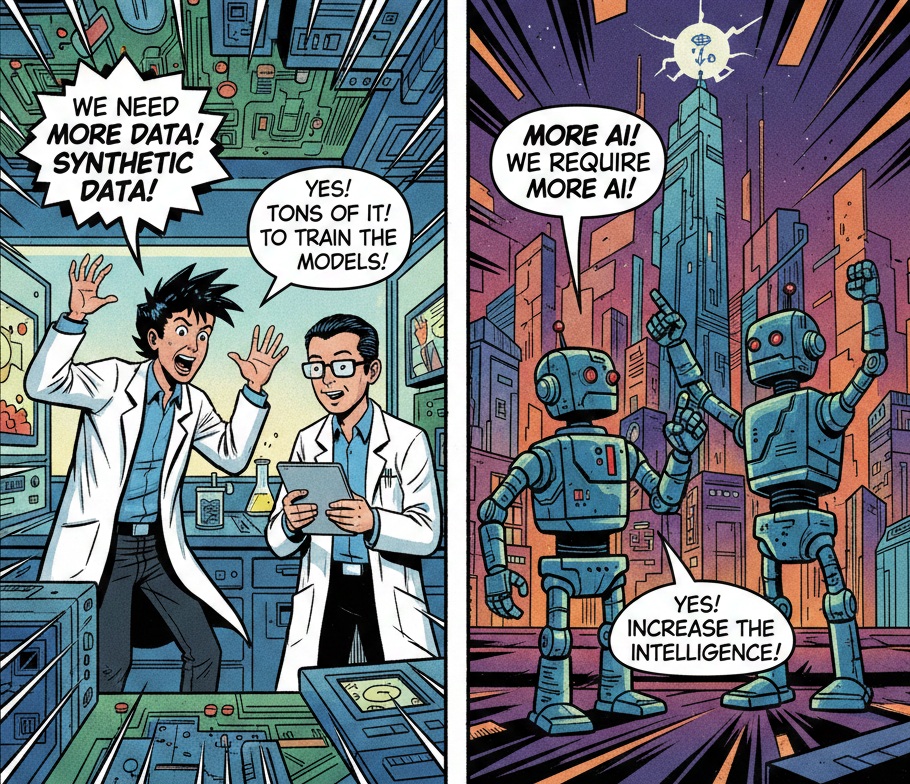
Annotating data by hand in 2026 is considered a form of digital archeology. Modern CV engineers build data engines, not datasets. But the real shift is towards World Models.
As Yann LeCun famously argued with his JEPA (Joint-Embedding Predictive Architecture), true intelligence requires internal models that predict how the world evolves. In 2026, we've moved past simple frame-to-frame prediction. We now train models that understand causality and physics within a latent space. If you're building for robotics or autonomous systems, understanding V-JEPA is no longer optional - it's the baseline.
- What to learn: NVIDIA Omniverse-style simulation, JEPA architectures, and unsupervised world model pre-training (DINOv3-style self-supervised learning).
4. Full-Cycle Ownership: The "Build-it-All" Mentality
Here's the hard truth: nobody cares if you can just train a model anymore. In 2026, the industry is looking for engineers who own the entire feature life cycle. If you can't take a feature from a napkin sketch to a running production service, you're just a researcher in an engineer's clothing.
Being "Full-Cycle" means being responsible for:
- Data Pipeline: Managing your own collection and weak-labeling strategies.
- Infrastructure: Containerizing your models with Docker and optimizing them for deployment via Triton, TensorRT, or edge-specific runtimes like MNN, ONNX Runtime, and TFLite.
- MLOps: Setting up CI/CD for your weights and monitoring for data drift in the wild.
The distance between "it works on my GPU" and "it works for 10M users" is where the best salaries are hidden. 💸
5. System Design in the "Vibe Coding" Era
Welcome to the era of Vibe Coding. With LLMs handling 80% of the boilerplate, "knowing the API" is a low-tier skill. What matters now is Architectural Intuition. In a 2026 system design interview, you won't be asked to write a shader; you'll be asked how to architect a real-time multimodal feedback loop for a surgeon's AR headset.
Hiring managers want to see if you understand the product logic: How does the AI failure mode affect the UX? Where is the bottleneck: latency, bandwidth, or compute? If you can't "vibe" with the product's fundamental functioning, no amount of clean code will save you.
Interviewing in 2026: The "Vibe Check"
You might think that because we have AI that writes code, interviews are easier. Wrong. They just shifted. Companies now care more about Architectural Intuition than whether you remember the formula for Batch Norm (spoiler: we don't use it as much anyway).
And yes, before you ask: the Good Old Leetcode is still here. Why? Because it's the ultimate filter for "can this person actually think when they're stressed?" So don't throw away those Python scripts just yet. 🐍
Stay curious, keep your gradients flowing, and remember: in 2026, the only constant is that your weights will be outdated by next Tuesday. 🔥